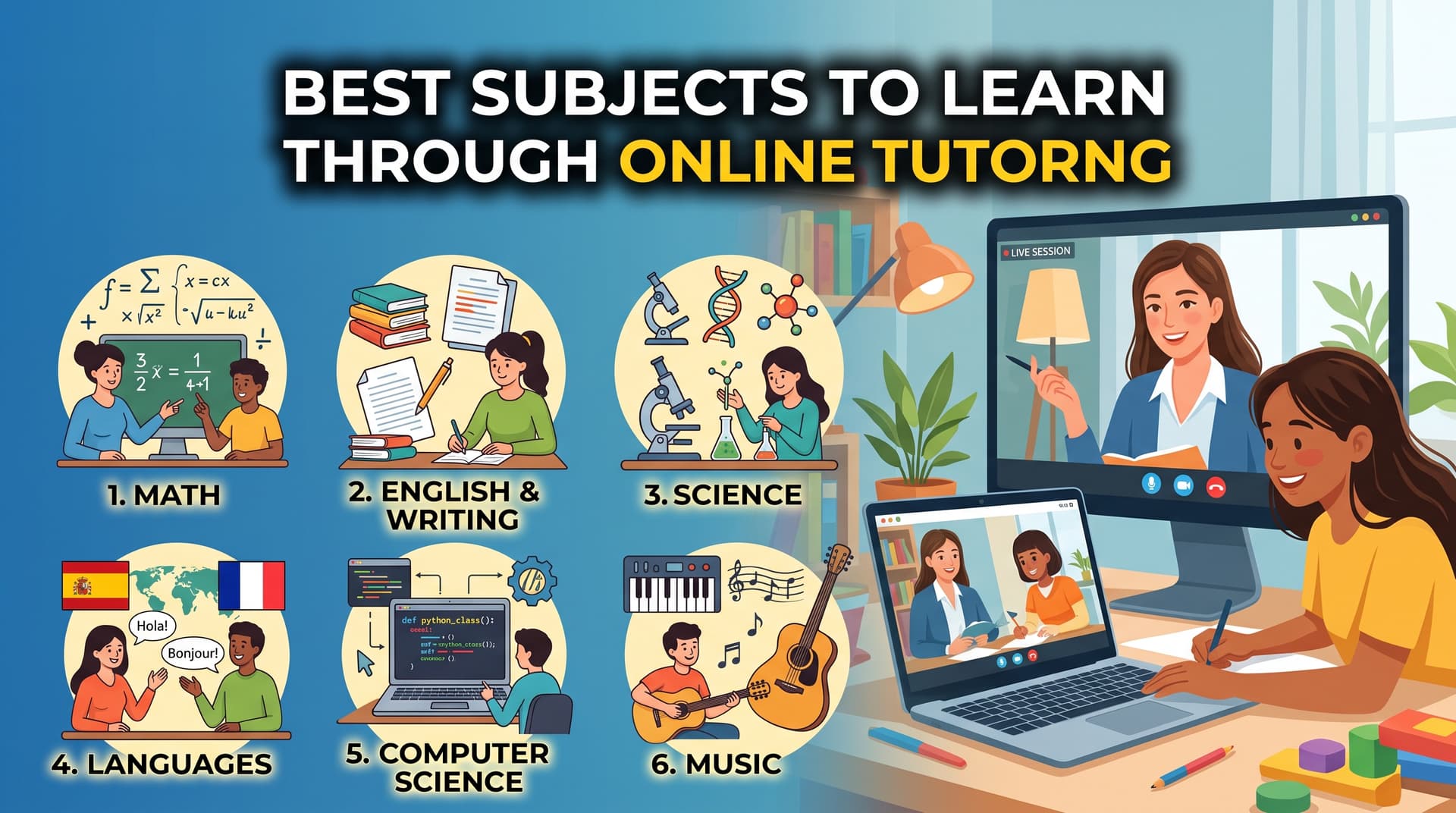
Best Subjects to Learn Through Online Tutoring
23/09/2026
Best Subjects to Learn Through Online Tutoring (And Why They Work So Well Virtually)
Introduction: Not All Subjects Are Equal Online — But Most Do Just Fine
When online tutoring first became mainstream, a common worry among parents was whether learning through a screen could really replace sitting across a table from a tutor. Years of classrooms going virtual — and thousands of students learning successfully online — have answered that question: for most subjects, an online tutor can be just as effective as an in-person one, provided the subject and the tools are matched well.
Some subjects, in fact, are better suited to online tutoring than to a traditional home session. Digital whiteboards, shared documents, coding sandboxes, and instant screen-sharing give online tutors tools an in-person tutor simply doesn't have. Below is a breakdown of the subjects where online tutoring consistently delivers strong results — and why.
Top Subjects for Online Tutoring
1. Mathematics
Math is one of the most popular subjects for online tutoring, and for good reason. A digital whiteboard lets a tutor and student work through equations step-by-step in real time, and recorded sessions mean a student can rewatch exactly how a problem was solved. From basic arithmetic to calculus, an online tutor can visually break down each step without the back-and-forth of erasing a physical notebook.
2. Coding and Computer Science
Few subjects translate to online learning as naturally as coding. Students and tutors can share a live coding environment, run code together in real time, and debug side by side — something that's often more efficient online than on paper. Whether it's Python fundamentals, web development, or exam-focused computer science, an online tutor can walk through actual working code with the student.
3. Foreign Languages
Language learning thrives on conversation practice, and video calls make that practice available with tutors from anywhere in the world — including native speakers. Online tutoring opens access to language tutors a family might never find locally, while screen-sharing supports vocabulary drills, grammar correction, and reading comprehension in real time.
4. Sciences (Physics, Chemistry, Biology)
Diagrams, chemical equations, and scientific processes are easy to illustrate using digital tools, virtual labs, and shared annotation. While hands-on lab work still benefits from in-person instruction, concept mastery, problem sets, and exam prep for physics, chemistry, and biology translate very well to online tutoring.
5. Standardized Test Prep (SAT, IELTS, TOEFL, JAMB, WAEC, and More)
Test prep is built around practice questions, timed drills, and reviewing mistakes — all of which work smoothly in an online format. Online tutors can share past questions, track a student's progress across sessions, and focus tightly on the specific sections a student needs to improve.
6. Academic Writing and Essay Skills
Shared documents make real-time editing simple: a tutor can comment directly on a student's essay, suggest revisions live, and walk through structure and argument-building without ever needing a printed copy. This makes online tutoring an efficient way to improve writing skills at any grade level.
Why Online Tutoring Works So Well for These Subjects
Real-time screen-sharing lets tutors demonstrate exactly what they mean, instantly
Digital whiteboards replicate — and often improve on — a physical notebook or blackboard
Recorded sessions let students revisit exactly how a concept was explained
Access to specialized tutors removes location as a barrier, especially for less common languages or advanced subjects
Flexible scheduling makes it easier to fit sessions around school, exams, and family life
Is Online Tutoring Right for Every Student?
Online tutoring tends to work best for students who are comfortable with basic technology and can stay focused during virtual sessions. Younger children may need a parent nearby to help with the setup, while older students and teenagers often adapt to the format quickly. For hands-on subjects requiring physical practice — like certain lab sciences or fine motor skills — a blended approach with occasional in-person support can work well alongside online sessions.
Frequently Asked Questions About Online Tutoring
What is the best subject to learn with an online tutor? Math, coding, and foreign languages are consistently the strongest fits for online tutoring, thanks to tools like digital whiteboards, live code editors, and video-call conversation practice.
Is online tutoring as effective as in-person tutoring? For most academic subjects, yes. Studies and widespread classroom experience have shown that online tutoring can match in-person results when paired with the right digital tools and an engaged tutor.
How do I find a good online tutor? Look for a vetted, background-checked online tutor with proven experience in the specific subject your child needs. Platforms like Find a Teacher connect parents and students directly with verified online tutors across a wide range of subjects.
Can online tutoring help with exam preparation? Yes — online tutoring is especially effective for standardized test prep, since it allows for structured, timed practice sessions and focused review of past questions.
Find the Right Online Tutor for Any Subject
Whether your child needs help with math, coding, a new language, or exam prep, the right online tutor can make virtual learning just as effective as sitting across the table. Explore vetted, background-checked online tutors matched to your child's subject and goals at Find a Teacher.